



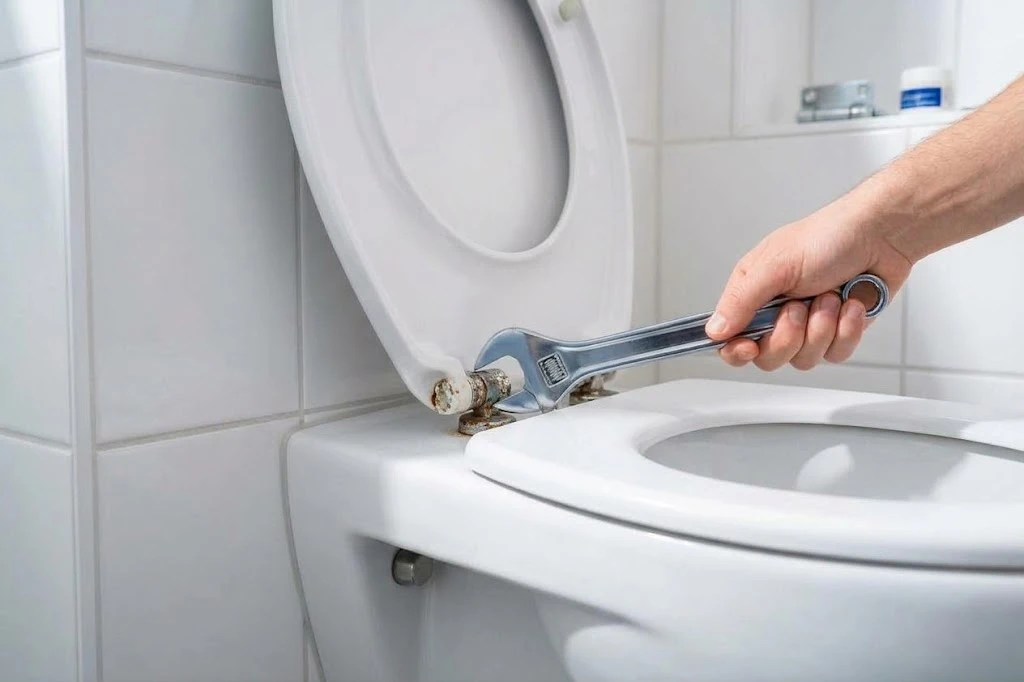
You’ve decided to replace your toilet seat, but when you lift the cover caps you find rusted fixing bolts. They won’t budge: they’re seized, eaten away by moisture and limescale. Don’t panic. Here’s how to deal with it and, above all, how to make sure it never happens again.
Why are my toilet seat bolts rusted?
A toilet is a damp environment by nature. Between water splashes, condensation and sometimes harsh cleaning products, metal parts suffer over time. Toilet seat fixing bolts are particularly exposed because they sit at the back of the bowl, an area that is often hard to reach and rarely cleaned thoroughly.
Toilet seat bolts usually start to rust after a few years of use. The process speeds up if the bolts are made of untreated steel or if the room is poorly ventilated. Limescale in the water makes things even worse by forming a hard crust around the thread, which makes unscrewing them almost impossible by hand.
Rusted toilet seat bolts: methods to get them off
When the rusted bolts on your toilet seat refuse to move, there are several techniques to try before reaching for the angle grinder. Here are the most common ones, from the gentlest to the most drastic.
Penetrating oil: your first move
Apply a generous amount of penetrating oil such as WD-40 to the bolts and nuts. Leave it to work for at least 15 to 20 minutes, or even several hours if the rust is well established. Then try to unscrew with an adjustable spanner or water pump pliers, holding the nut from underneath. According to feedback from professional plumbers, this method works in around 60% of cases.
White vinegar and bicarbonate of soda
If you don’t have penetrating oil to hand, warm white vinegar can do the job. Soak a cloth and wrap it around the bolt for a good hour. You can also make a paste of bicarbonate of soda and vinegar, which reacts and attacks the rust. It’s no miracle cure for the most severe cases, but it’s worth a try before moving on to the next method.

Cut the bolt with a saw or a rotary tool
When nothing works and the rusted toilet seat fixing remains stubbornly stuck, sometimes the only option left is to cut it. To do this, you can use:
- a mini hacksaw (junior hacksaw) to cut the bolt from underneath
- a rotary tool such as a Dremel fitted with a cutting disc
- sturdy side cutters if the nut is easy enough to reach
Be careful not to scratch the ceramic of the bowl: protect the surfaces with thick tape before you start. Allow 10 to 30 minutes depending on how hard the bolt is and the tool you use.
Call a plumber
If you don’t feel comfortable doing this yourself, a plumber can step in quickly. Replacing a toilet seat with seized fixings typically costs between €50 and €100 including labour, depending on the region and how difficult the job is.
The real problem: a fixing system that ages badly
Let’s be honest: if your toilet seat bolts are rusted, it’s no accident. It’s a design flaw found on the vast majority of toilet seats sold in shops. The through-bolt and nut fixing system, used for decades, was never designed to withstand the constant humidity of a bathroom.
Every time you change your toilet seat, you’re likely to face the same problem. And over time, it only gets worse. The rust spreads, the bolts weaken and the risk of damaging the bowl when forcing them increases.

The Papado solution: a screwless toilet seat with no rust and no hassle
It’s precisely to solve this recurring problem that Papado developed a completely different system. Its toilet seat kit uses a clip system that attaches to the bowl without a single metal screw. You fit the base, clip the seat on, and you’re done.
The result: no more rusted bolts on your toilet seat fixings. The system is made from materials that resist moisture and limescale. And because the seat comes off in one movement, cleaning the bowl becomes much easier, especially at the back, where bacteria and dirt build up.
Installation takes less than 5 minutes, with no tools, and the system is compatible with most standard toilet bowls on the European market. For anyone who has already spent an hour trying to free rusted bolts, it’s a real relief.
Looking after your toilet to avoid nasty surprises
To make a toilet seat last, it needs regular care. Once a month, clean the area around the fixings with a descaler, then dry it thoroughly to prevent rust.
With the Papado clip-on toilet seat, cleaning takes 5 minutes. Unclip it, rinse it in the shower or bath, and clip it back in place. Between deep cleans, Papado wipes are handy for a quick freshen-up.
To personalise your clip-on seat, you can also add a Papado sticker: marble, flowers, mosaic… several designs are available.
Summary: solutions for rusted toilet seat bolts
| Method | Difficulty | Effectiveness |
|---|---|---|
| Penetrating oil (WD-40) | Easy | Moderate to good |
| White vinegar + bicarbonate of soda | Easy | Low to moderate |
| Cutting with a saw / Dremel | Moderate | Very good |
| Professional plumber | None (outsourced) | Excellent |
| Switch to a Papado clip-on toilet seat | Very easy | Permanent |
The long-term fix: the Papado screwless toilet seat
Removing rusted bolts from a toilet seat is a hassle thousands of people go through every year. If you’re reading this article, you know exactly what we mean. The methods above should help you sort things out in most cases. But if you want a lasting solution and never want to worry about rusted toilet fixings again, switching to a clip-on toilet seat is still the best decision. No more bolts, no more rust, no more stress when it’s time to replace it.